
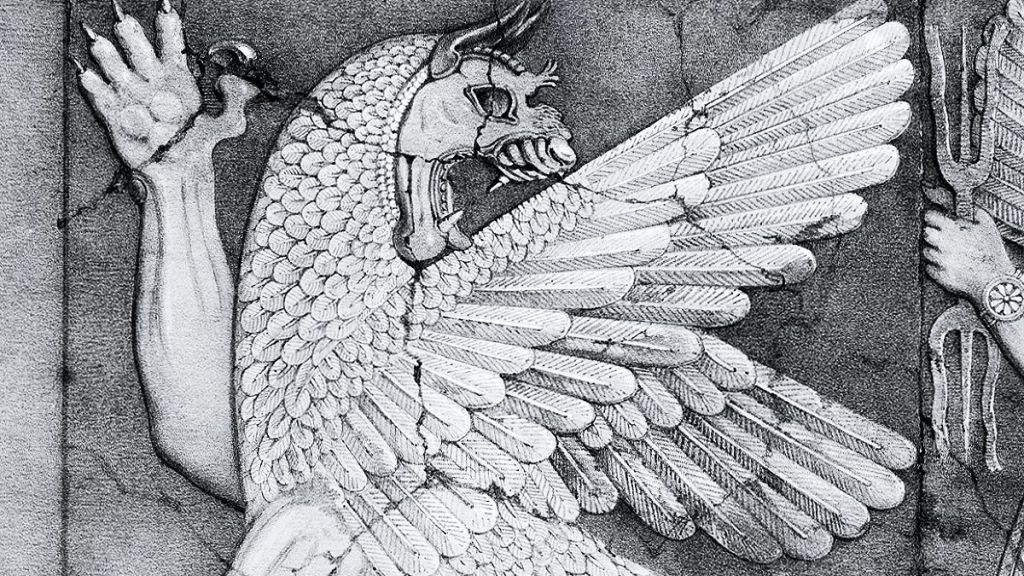
The Combat Myth is a supernatural battle between order and chaos (or good and evil). This is a common story line in the mythologies of civilizations throughout the Ancient Near East. We even find remnants of it in the Old Testament story of Yahweh.
We’ll start with an Akkadian myth that developed about a thousand years before the stories of Yahweh in the Old Testament. The Akkadian Empire followed Sumer as the primary Mesopotamian civilization.
In the Akkadian pantheon, Enlil was the king of the gods. Kingship was invested in the god who held the Tablet of Destinies, which showed all that had happened and all that would happen.
The griffin-like Anzu, assistant to Enlil, stole the Tablet and flew away, and chaos threatened order. Kingship would go to the god who restored order, but none responded to the challenge. Finally, Ninurta, an unimportant god to that point, volunteered. After defeating Anzu and restoring order, Ninurta ascended to become the king of the gods.
From examples like these in ancient Near Eastern literature, we can distil out the elements in the Combat Myth. It begins with a chaotic threat to the council of the gods. None of the gods from the older generation is willing to face the challenge, but a young god steps up. He defeats the monster and becomes the new chief god.
Another myth from this region comes from Ugarit, just north of Israel, from roughly 1300 BCE. This is the environment from which proto-Judaism emerged. In this myth, El is the chief god, and Baal (“Lord”) volunteers to fight the chaos threat. Baal uses a supernatural club to kill Yam (“Sea”), the serpent-like sea god. Next, Baal fights Mot (“Death”), another threat to order. Baal dies in this battle but is brought back to life to finally defeat Mot.
Early Judaism had the same council of gods as in earlier Ugaritic mythology. Yahweh was a son of El (also called Elyon) and just one of many in the council of the gods. Yahweh received Israel as his inheritance, and other gods in the council were given their own tribes to rule. Deuteronomy says, “When Elyon divided the nations, when he separated the sons of Adam, he established the borders of the nations according to the number of the sons of the gods. Yahweh’s portion was his people, [Israel] his allotted inheritance.”
We see the Bible’s Combat Myth in Psalms where Yahweh slays the chaos monster Rahab (another name for the sea monster) and becomes king of the council of the gods: “The heavens praise your wonders, Yahweh, your faithfulness too, in the assembly of the holy ones. For who in the skies above can compare with Yahweh? Who is like Yahweh among the heavenly beings? In the council of the holy ones God is greatly feared; he is more awesome than all who surround him.”
We find the Combat Myth first in Mesopotamian religions and then in the story of Yahweh. This shows that Yahweh developed from these earlier myths.
Continue to chapter 43.
Image credit: Wikimedia (public domain)
Notes
Myth: In common speech, “myth” means “false story,” but to scholars, the label isn’t a judgement about its truth. Rather, a myth is a sacred narrative that explains some aspect of reality. For example, Genesis has two different creation myths that explain where everything came from.
Akkadian empire: This empire began in the 2300s BCE with Sargon, its first ruler, and lasted for two centuries. It extended from Syria to the Persian Gulf. From its collapse came Assyria in the north and (a few centuries later) Babylonia in the south.
“When Elyon divided the nations”: Deuteronomy 32:8–9. This is the Dead Sea Scrolls version, and the translation is from Thom Stark, The Human Faces of God (Wipf & Stock, 2011), 71–2.
“The heavens praise your wonders”: Psalm 89:5–7.
 2-Minute Christianity
