10 The Society that Christianity Gave Us: Monsters, not Medicine

An ancient and curious map illustrates the backwards society we have inherited from Christianity.

Hereford Cathedral in England has the world’s largest mappa mundi, a parchment map of the world made in roughly 1300. This is not the kind of map we’re used to. It wouldn’t serve an explorer or navigator, and its creators didn’t claim that it would.

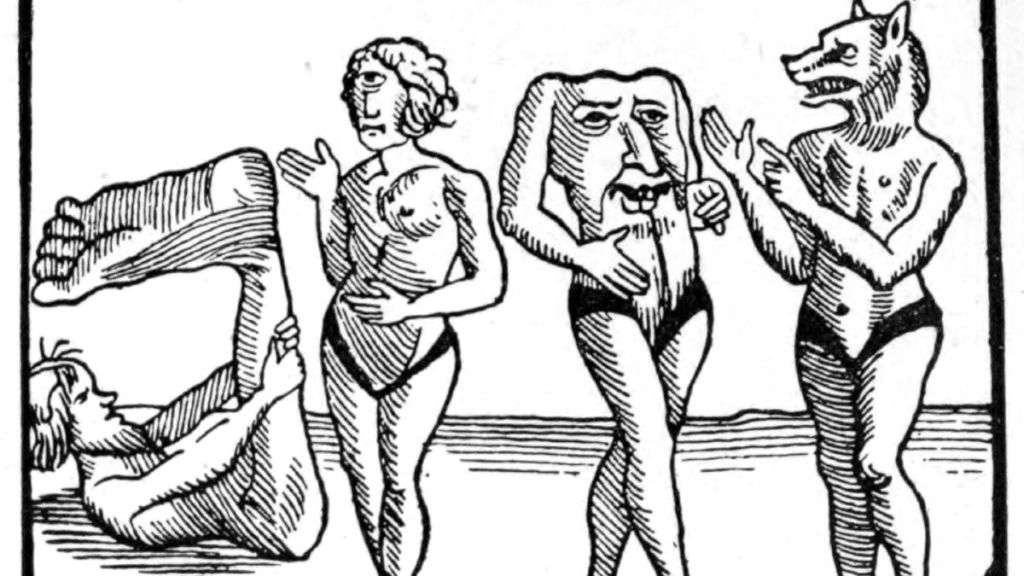
Using the theme of a world map, medieval cartographers embellished maps like this one to make them into something of an encyclopedia. With science in its infancy, however, the information can be bizarre, and the zoology sounds more appropriate for Alice’s Wonderland. This map documents the Sciapods, people with a single large foot that they used to shield themselves from the sun. The Blemmyes were warlike and had no head. Instead, their face was in their chest. The Cynocephali were dog-headed men, and Troglodites are “very swift; they live in caves, eat snakes, and catch wild animals by jumping on them.”

As with all mappae mundi, this one puts Jerusalem in the center. It shows places of biblical importance such as the Tower of Babel, the Garden of Eden, the route of the Exodus, and Sodom and Gomorrah. Mythology and history are mixed without distinction. We see Jason’s Golden Fleece and the Labyrinth where Theseus killed the Minotaur, but we also see the camp of Alexander the Great.

When Christianity was in charge, this is what it gave us. Mythical creatures populated the world, we had little besides superstition to explain the caprices of nature, and natural disasters were signs of God’s anger.

Christianity’s goal isn’t to create the internet, GPS, airplanes, or antibiotics. It isn’t to improve life with warm clothes or safe water. It isn’t to eliminate diseases like smallpox or polio. It’s to convince people to believe in a story that has negligible evidence.

Admittedly, it’s not like Europeans of the 1300s had many options, and Christianity might have offered a better explanation than nothing. Today, we have had a couple of centuries to test modern science, and we know that it delivers. Nevertheless, we still find God-centric mappa mundi thinking today. For example, the Westminster Shorter Catechism says that “Man’s chief end is to glorify God and to enjoy him forever,” not improve society, and even today some Christian leaders declare that natural disasters come from God.

If Christianity is what you create in the absence of science, why is it still here? The metaphor of assembling an arch illustrates the problem. First, build an arch-shaped scaffold. Next, lay the stones of the arch. Finally, remove the scaffold. Once the stones of the arch are in place, they support themselves and don’t need the scaffold.

That’s how religion works. Superstition in a world before science was the scaffold that supported the arch of religion. Science has now dismantled the scaffold of superstition, but the arch of religion has already calcified in place.

It’s the twenty-first century, and yet the guiding principles for Christians’ lives might as well come from the fourteenth, back when the sun orbited the earth, disease had supernatural causes, and distant lands had Sciapods, Blemmyes, and Troglodites.

Continue to chapter 11.

Image credit: Wikimedia (public domain)
9 Original Sin: God’s Punishment of Adam and Eve

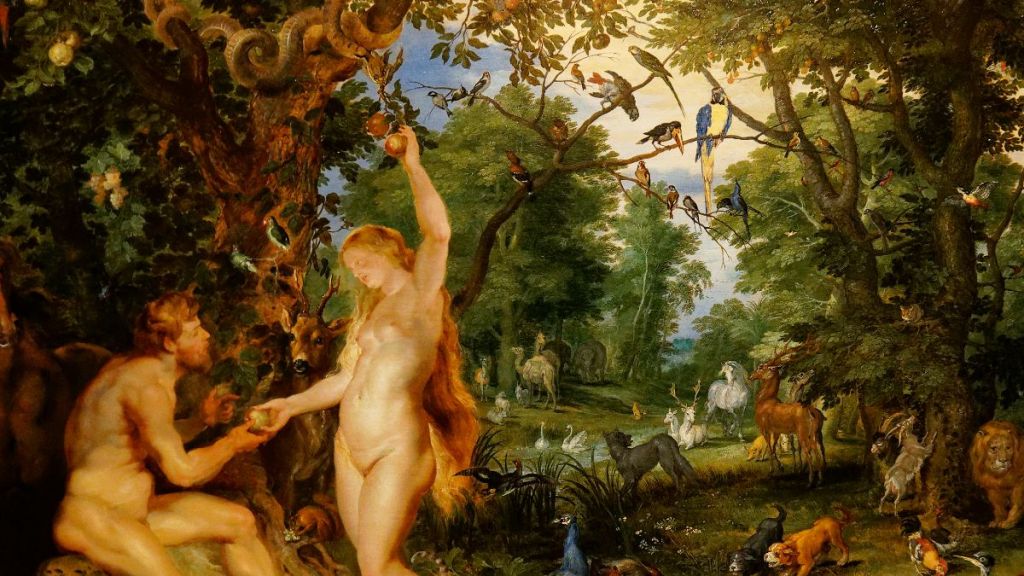
Central to the Christian message is that we are irrevocably sinful because of Adam and Eve in the Garden of Eden. Their sin was the original sin, we inherit it, and we need Jesus to remove it.

The Garden of Eden story is one of two creation stories in Genesis. In it, God permits Adam and Eve to eat any fruit in the Garden except for that from the Tree of the Knowledge of Good and Evil. Encouraged by a serpent, they disobeyed.

Four in ten Americans see the Garden of Eden story as history. Look skeptically, though, and it doesn’t even hold together as a coherent story.

As crimes go, eating the fruit was a misdemeanor. Admittedly, Adam and Eve did disobey God, but this was the first sinful act in their lives. How about a scolding instead? Perpetual punishment through the generations is out of proportion to this crime. And even if they deserved punishment, why punish all their descendants? Elsewhere, the Bible agrees, “Parents are not to be put to death for their children, nor children put to death for their parents; each will die for their own sin.” God contradicts himself in his own book and undermines the basis for original sin.

Were Adam and Eve even blameworthy? Moral knowledge in this story comes from eating from the Tree of the Knowledge of Good and Evil, so before that, they couldn’t have understood morality. Blaming them for doing something wrong was like punishing a one-year-old for a moral infraction.

If we’re inheritors of Adam’s moral knowledge as well as his sin, then Man must thoroughly understand good and evil today. Why then are we so bad at figuring it out? Shouldn’t we all agree? Why are post-Eden humans divided on issues like abortion, same-sex marriage, euthanasia, and capital punishment? Christians can’t even agree among themselves.

Since the Bible makes clear that wisdom is good (“How much better to get wisdom than gold, to get insight rather than silver!”), why is getting wisdom a bad thing? Solomon was celebrated for his wisdom, and yet Adam and Eve were punished for gaining it.

Think about the illogic of a garden with a dangerous tree in it. God knew that humans mustn’t eat from the Tree, so where does he put it? In with the humans! True, God was new at parenting, but some safeguards are common sense. Why not warn Adam and Eve about the serpent or make the fruit of the tree smell unappealing or put a wall around it? God knew how to make effective safeguards, since he put cherubim with a flaming sword to keep mankind out of the Garden after the Fall, so why not guard the tree beforehand?

Even the punch line of the story fails. God said, “When you eat from [the Tree,] you will surely die,” but the serpent was right, and Adam and Eve didn’t die. Nor can this be rationalized by saying that they would now die eventually because they never were immortal—that’s what the Tree of Life was for.

The Garden of Eden story works as a fable but not as a coherent account. Not only does being burdened with an ancestor’s sin clash with our moral sense, the Bible itself agrees. Without transgenerational guilt, original sin has no basis, and without original sin, Jesus had nothing to save us from.

Continue to chapter 10.

Image credit: Txllxt TxllxT (CC BY-SA 4.0) via Wikimedia

Notes

Four in ten Americans see the Garden of Eden story as history: “Evangelicals Question The Existence Of Adam And Eve,” NPR, August 9, 2011, www.npr.org/2011/08/09/138957812/evangelicals-question-the-existence-of-adam-and-eve.

“Parents are not to be put to death for their children, nor children put to death for their parents; each will die for their own sin”: Deuteronomy 24:16.

“How much better to get wisdom than gold, to get insight rather than silver!”: Proverbs 16:16.

8 Ontological Argument: Wishing Things into Existence

Anselm of Canterbury (d. 1109) formulated the original Ontological Argument a thousand years ago: first define “God” as the greatest possible being that we can imagine. Next, consider existence only in someone’s mind versus existence in reality—the latter is obviously greater. Finally, since “God” must be the greatest possible being, he must exist in reality. If he didn’t, he wouldn’t meet the definition of the greatest possible being.

This is a popular argument for Christianity, but how is this not wishing something into existence? If we can simply think God into existence, what else can we think into existence?

There are other issues: look at that first step in the argument. It defines God as the greatest possible being that we can imagine. But in step three, we are talking about beings that exist, and the definition of “God” from the first step no longer applies. Definitions have switched mid-argument.

Next, “greatest” is subjective. Was the English military victory at Agincourt or the Greek holding action at Thermopylae greater? Was the Hoover Dam or the Taj Mahal the greater civil engineering project? Is the greater god the omnipotent one, or is he the one limited in power but who surpasses his limitations by getting things done through cooperation? The greatest possible being is like the highest integer—you can always go a little higher.

God from the first point in the argument (God is the greatest being that we can imagine) is undefined, just like the greatest political candidate. These are subjective categories.

Next, given the genocide, slavery, and other backwards thinking in the Old Testament, God is clearly not the Greatest Possible Being.

Next, the Greatest Possible Being is perfectly satisfied and has no needs. No needs means no motivation to change or create, so it can’t be the creator of our universe.

Next, if we’re just imagining things into existence, other less-pleasant things could come along as well. The Ontological Argument invites its negative version: define “God” as the worst possible being that we can imagine. Then consider existence only in someone’s mind versus existence in reality—it would obviously be worse if this being actually existed. Finally, since “God” must be the worst possible being, he must exist in reality.

Lastly, many philosophers have rejected the argument. David Hume observed that to think of a unicorn (for example) is to think of it existing. Adding a second step, “Now think of the unicorn existing,” is meaningless. The same is true for God—the idea of God is the idea of God existing, and the argument no longer works.

The Ontological Argument is effective, not because it’s right, but because it’s perplexing. A God who wanted a relationship with humans wouldn’t be findable only through opaque arguments.

Continue to chapter 9.

Image credit: in hiatus (CC BY 2.0) via flickr

Notes

Anselm of Canterbury: Born in Italy, Anselm became abbot of an abbey in Normandy, France. He became the second archbishop of Canterbury installed after the conquest of England by William, Duke of Normandy. He died in 1109 and was canonized in 1163.

xkcd cartoon: www.xkcd.com/1505.

7 Psalm 22 Prophecy: Not a Good Fit for Jesus

Psalm 22 is a popular place to look for Old Testament prophecies fulfilled by the life of Jesus. Christian apologists (that is, defenders of Christianity) claim that it closely parallels the crucifixion story, even though it preceded Jesus by roughly a thousand years.

This argument is compelling only if we examine verses that support it and ignore others. Taken as a whole, this chapter is no prophecy of the crucifixion.

Let’s first consider verses that support the argument.

•  The very first verse of Psalm 22 is, “My God, my God, why have you forsaken me?” which are the last words of Jesus according to the gospels of Matthew and Mark.

•  “All who see me mock me; they hurl insults, shaking their heads. ‘He trusts in the Lord,’ they say, ‘Let the Lord rescue him.’” Sure enough, Mark records the onlookers insulting Jesus and mocking his inability to free himself.

•  “They divide my garments among them and cast lots for my clothing,” as noted in Mark.

The author of Mark was surely familiar with Psalm 22 and could have added the distribution of clothes, the mocking from the crowd, and the last words to his gospel. No supernatural prophecy is needed if Mark lifted these elements from Psalm 22.

Let’s reconsider those last words, “My God, why have you forsaken me?” Not only does forsaking Jesus not sound like part of God’s plan, this doesn’t sound like the cool-headed Jesus we find in the crucifixion stories in Luke and John.

The apologetic argument points to intriguing little fragments, but taken as a whole this doesn’t look at all like the crucifixion story. Consider the entire chapter, and we find verses that paint a different picture.

•  “Yet you brought me out of the womb; you made me trust in you”—again, this sounds like an ordinary man. The first person of the Trinity wouldn’t need to make the second person of the Trinity trust him.

•  “Many bulls surround me…. Roaring lions tearing their prey open their mouths wide against me.” Bulls and lions? That sounds like a spectacle in an arena, not crucifixion.

•  “I can count all my bones.” This unfortunate man must be starving, but (again) this isn’t the gospel story.

•  “Deliver my life from the sword, my precious life from the power of the dogs. Rescue me from the mouth of the lions; save me from the horns of the wild oxen.” Yet again, not the gospel story.

A final problem with shoehorning Psalm 22 into the gospel story is that there’s no reference to the resurrection. This can hardly be the story of the sacrifice of Jesus if it omits the conclusion.

When read completely and without presupposition, Psalm 22 doesn’t sound at all like a summary of the crucifixion story.

Continue to chapter 8.

Image credit: Manik Roy via Unsplash

Notes

the last words of Jesus according to the gospels of Matthew and Mark: Matthew 27:46 and Mark 15:34.

Mark records the onlookers insulting Jesus: Mark 15:29–32.

“They divide my garments” … as noted in Mark: Mark 15:24.

6 Argument from Desire: Can Desire Prove God’s Existence?

This Christian argument looks at innate human desires and sees a hint of God. We feel hunger so therefore there must be food, we desire companionship and therefore there are other people, and we yearn for the supernatural, so therefore there must be a god.

This reasoning is easy to understand and has an intuitive appeal, but it fails under closer inspection. If our feelings are a reliable instinctual pointer to the supernatural, why then do we fear death? If we instinctively know there is a god and an eternal place for our soul after life on earth, humans should differ from other animals in having an ambivalence about death or even a longing for it. We don’t.

This argument imagines that hunger points to the existence of food, but it’s the other way around. It’s as backward as the thinking of Douglas Adams’ puddle, which marveled at how well-crafted its hole was. We don’t notice hunger and then conclude that food must exist; rather, animals need food to survive, and evolution selects those that successfully strive to get it.

This argument lists fundamental, innate, physical needs and drives like food, water, sex, safety, and sleep. It could also add higher-level desires for beauty, justice, knowledge, friendship, love, or companionship. The Christian may want to avoid the skeptic adding Aladdin’s lamp or superpowers to the list and so reject anything that doesn’t obviously exist. But if we’re to keep food and drink (which we know exist) and reject magic lamps and superpowers (which we don’t know exist), we must be consistent and discard God. And note that if the desires for food, water, sex, and other basics are never fulfilled, the human race dies out. By contrast, hunger for the supernatural has nothing to do with survival. The hazy desire for a god to make everything right doesn’t logically fit in with mandatory drives. Calling the desire for God innate is hard to justify when we share basic drives for food, water, and so on with other social animals but not a desire for the supernatural.

C. S. Lewis said, “It would be very odd if the phenomenon called ‘falling in love’ occurred in a sexless world.” But is it odd? People believe you can talk to the dead or that the motion of the planets affects your life, and yet these beliefs are false. It’s not at all odd that humans desire things that don’t exist.

We can imagine perfect justice, world peace, or a loving god, but that doesn’t make them reality. As with the Ontological Argument in chapter 8, thinking of it doesn’t make it so.

Wishful thinking in religion is like wishful thinking in a store’s health and beauty aisle, or in diets, or in end-of-life care. It’d be great to look younger or live longer, and it’d be great to have an all-powerful Friend looking out for you. That doesn’t make it so. As with claims for cosmetics and cure-alls, we must be skeptical.

Continue to chapter 7.

Image credit: anokarina (CC BY-SA 2.0)

5 Jesus, the Great Physician (May Not Be so Great)

doctors with masks

Jesus is called the Great Physician, but the stories of healing miracles of Jesus in the gospels document outdated and false notions about disease. Here are some examples.

Sickness can come from sin. Jesus healed a disabled man but warned him, “You are well again. Stop sinning or something worse may happen to you.”

Evil spirits cause disease. Demons caused insanity in a man, and Jesus expelled them into a herd of pigs, which ran into a lake and drowned. We also read that demons can cause physical crippling.

Potions can cure disease. Jesus healed a blind man by making mud with his spit and putting that on the man’s eyes. After rinsing, the man could see. In the parallel story from another gospel, Jesus needed two tries to get it to work.

Jesus heals by touching. Jesus used touch to cure a leper, a person with a fever, and two blind men. He also raised the dead.

Touching Jesus can heal. Touching Jesus healed a woman without Jesus doing anything, as if he were a medicine battery: “At once Jesus realized that power had gone out from him.”

Spells can heal. The Bible carefully recorded the words Jesus used to heal: the Aramaic words ephphatha to cure a mute man and talitha koum to raise a dead girl.

Healing works over distance. Jesus didn’t even need to be there. For example, he healed the centurion’s servant remotely.

It’s unclear what to make of this hodge-podge of techniques except to wonder why Jesus didn’t just put up his feet and heal thousands of worthy people remotely or eliminate entire diseases like cancer and smallpox.

The gospels say he was motivated. In Matthew, Jesus was moved by compassion and healed the sick in a crowd. “His heart went out” to a woman at her only son’s funeral, and he raised the son from the dead. He healed people, at least in part, for the same reason a modern doctor does, because of compassion. He also used healings as proof of his divinity.

Compare Jesus’s approach with modern medicine. Jesus healed lepers. We don’t heal lepers with miracles but with antibiotics. Leprosy is no longer much of a problem, as is true for smallpox, plague, polio, and many other diseases.

Jesus cast out demons. We don’t because we have found only natural causes for disease and can conclude that demons aren’t a factor. While we can’t cure all illnesses, we do a better job now that we’re focused on the actual causes.

Jesus restored sight and hearing. Modern medicine has made remarkable progress, not only in restoring sight and hearing but in preventing illness before it happens.

Jesus raised the dead. Modern medicine has saved thousands from conditions that just a century ago would have killed them.

These Bible stories are a fascinating look at an ancient view of health when there was no alternative, but modern medicine shows that science is much more effective than Jesus.

Continue to chapter 6.

Image credit: National Cancer Institute via Unsplash

Notes

incestuous relations between Lot and his two daughters: Genesis 19:30–38.

“You are well again. Stop sinning or something worse may happen to you.”: John 5:14.

Demons caused insanity in a man, and Jesus expelled them into a herd of pigs: Mark 5:1–20.

demons can cause physical crippling: Luke 13:10–13.

Jesus healed a blind man by making mud with his spit: John 9:6–7 and Mark 8:22–5.

Jesus used touch to cure a leper, a person with a fever, and two blind men. He also raised the dead. Matthew 8:2–3, Luke 4:39, Matthew 20:34, Luke 7:14.

“At once Jesus realized that power had gone out from him”: Mark 5:30.

cure a mute man: Mark 7:33–5.

raise a dead girl: Mark 5:35–42.

[Jesus] healed the centurion’s servant remotely: Matthew 8:5–13.

“His heart went out”: Luke 7:13.

[Jesus] healed people . . . because of compassion: Matthew 14:14.

[Jesus] also used healings as proof of his divinity: Luke 7:22.

4 Christianity as Society’s Burden: Christianity Retarded Society by 1500 Years

A toy from roughly the time of Jesus shows what little Christianity did to improve society when it had the chance.

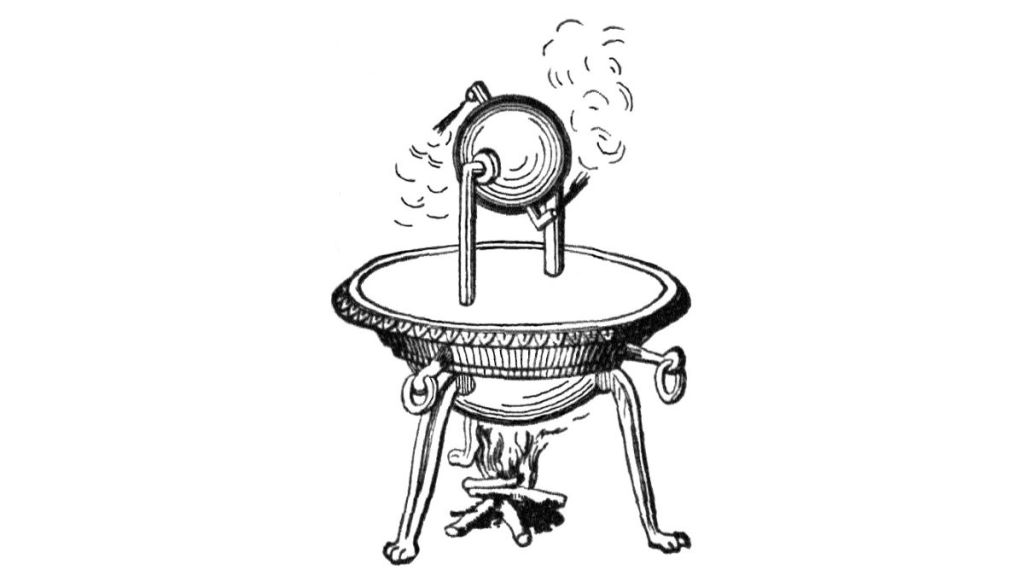
In the first century CE, Hero of Alexandria described the aeolipile, a steam-powered toy. It was a hollow metal sphere that rotated on an axle. The axle was hollow and carried steam into the sphere from a boiler below. The steam exited the sphere through two jets, which made it spin.

Remarkably, this steam turbine was never more than a curiosity. The Roman Empire built roads, bridges, coliseums, temples, and aqueducts that weren’t surpassed for centuries. If they had applied their engineering ingenuity to the ideas latent in this toy, the Romans might have developed steam-driven machinery 1700 years before the Industrial Revolution.

With the Christianization of the Empire in the fourth century, Christianity had the opportunity to improve the lot of its flock. Where was its Industrial Revolution? Where at least was the blossoming of a new, nurturing society driven by scientific innovation?

The Bible promised that God’s people would be vastly more prosperous than others. Jesus said, “No one who has left home or brothers or sisters or mother or father or children or fields for me and the gospel will fail to receive a hundred times as much in this present age.” God said, “Bring the whole tithe into the storehouse … and see if I will not throw open the floodgates of heaven and pour out so much blessing that there will not be room enough to store it.”

The period when Christianity was in charge in Europe didn’t stand out for the flowering of science and technology. There was innovation during the medieval period (eyeglasses, the water wheel, metal armor and gunpowder weapons, castles, crop rotation, and others), but that was in spite of Christianity, not because of it. In fact, much of this wasn’t native innovation but the adoption of foreign inventions.

The ledger on social improvement is also uninspired. For example, European countries didn’t outlaw slavery until 1500 years after Christianity took charge of European morality. Laws against slavery passed despite the teachings of the Bible, not in keeping with them.

Christianity could drive innovation if it wanted to. Consider the remarkable period of cathedral building beginning in the thirteenth century and the Church’s patronage of art during the Renaissance. But the technological and scientific advances driven by the Church were just to glorify itself. Any benefit to the people was inadvertent, and creating a better society wasn’t a goal of the church.

Science, not religion, delivered the health and prosperity that we have today. A peasant living in Europe in the year 1100 would have noticed little improvement a century later. Contrast that with the enormous jump between a century ago and today.

Christianity looks like just another human institution. There’s no evidence that it channels the power of the Creator of the universe. 

Continue to chapter 5.

Image credit: Wikimedia, public domain

Notes

“No one who has left home or brothers or sisters or mother or father or children or fields for me”: Mark 10:29–30.

“Bring the whole tithe into the storehouse … and see if I will not throw open the floodgates of heaven”: Malachi 3:10.

3 The Bible’s Shortsighted View of the Universe: A Cartoon Earth with Tiny Stars

We can find insight into the biblical worldview of the universe through Saul Steinberg’s famous New Yorker cover, “View of the World from 9th Avenue,” which mocks the outlook of the self-absorbed New Yorker. The buildings of central Manhattan are shown in sharp detail, but that detail fades with interest. Beyond the Hudson River to the west is a featureless “Jersey” and a rectangular United States with a few scattered state labels. Beyond that is the Pacific Ocean and a couple of distant countries. That’s it.

We get a corresponding view of the universe in Genesis. According to its Bronze Age view of science, God created the sky as a vault to separate the saltwater sea above from the earth below and the freshwater sea beneath that. This is Sumerian cosmology, which the Judean priesthood probably learned while in exile in Babylon during the 500s bce. We see this pre-scientific cosmology again in the flood story, where water comes from above and below because of the two hidden seas: “All the springs of the great deep burst forth, and the floodgates of the heavens were opened.”

In the Genesis creation stories, we read that on the fourth day, “[God] also made the stars.” In the original Hebrew, this phrase is just a single word. One word is all the Bible has to say about the 99.9999999999999999999999999% of the mass of the universe that’s not the earth. According to the Bible, all that is just a blue watery dome over Mesopotamia with little lights to guide us at night.

In the spirit of the New Yorker drawing, imagine a biblical version, a myopic “View of the World from Jerusalem.” Jerusalem and the rebuilt Temple would be in sharp detail in the foreground. Looking east, we’d see the Jordan River valley and the Dead Sea, and beyond that, boxes labeled Moab and Ammon, the Syrian Desert, and then Persia. At the horizon, we’d see the edge of the water dome that covered the world to make the sky. High up in that dome, we’d see the sun, moon, and tiny stars.

The Bible is a human document, and its perspective was that of superstitious, pre-scientific men.

You could say that this was a natural view for a primitive people and that they could grasp no more, but these people 2500 years ago weren’t fundamentally different from us. They had the same mental capabilities. The science in the Bible isn’t dumbed-down for simple people, it’s wrong. If we can understand and marvel at the view of the universe provided by modern science, so could they.

Many Christians today list all sorts of extraordinary qualities of God—new qualities that the authors of Genesis couldn’t have imagined. They say he’s infinite, beyond time, omniscient, and omnipotent. But the God that is said to have created our universe with 200 billion galaxies is not the God of Genesis who created Mesopotamia.

We have an awesome view of the universe today—from the aurora borealis to Saturn’s rings to distant nebulae—but we get that from science. Read the Bible honestly, and you’ll only find a cartoon universe that is a snapshot of Bronze Age thinking.

Continue to chapter 4.

Image credit: Wikimedia, public domain

Notes

God created the sky as a vault to separate the saltwater sea above from the earth below: Genesis 1:6.

“All the springs of the great deep burst forth”: Genesis 7:11.

“[God] also made the stars”: Genesis 1:16.

99.9999999999999999999999999% of the mass of the universe that’s not the earth: That’s not a made-up number. The mass of visible matter (only) in the universe is 6×1051 kg, while the mass of the earth is 6×1024 kg.

2 A Leaky Ark: The Noah Story Doesn’t Hold (Out) Water

Most Americans believe the Noah story is literally, word-for-word true, but the problems with the story are so overwhelming that it can only be myth.

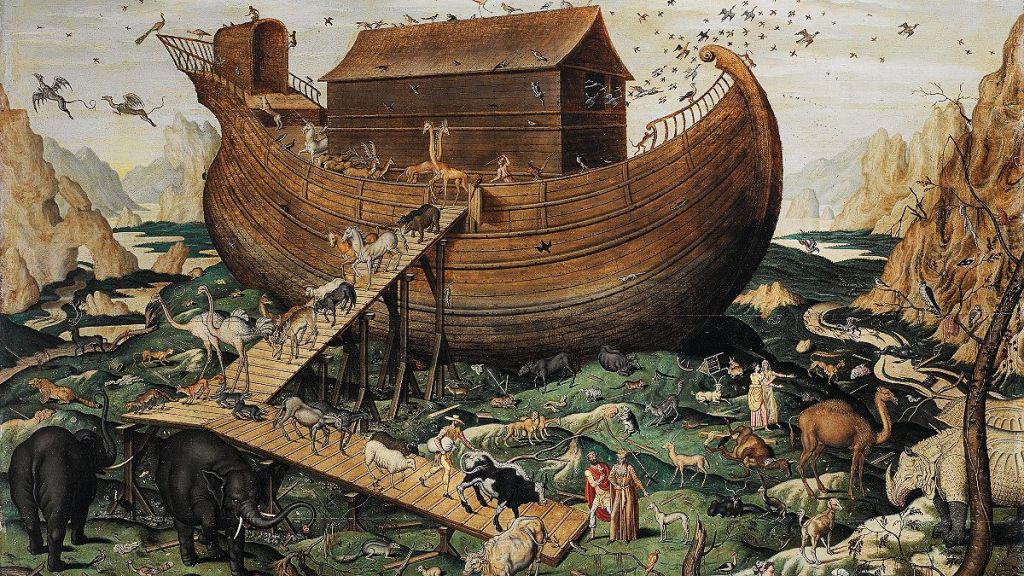
The ark was over a hundred meters long, making it the largest wooden ship ever built. It would have required tens of thousands of big trees. Where did the wood come from? Could Noah and his three sons have built such a ship by hand?

How could all the world’s species fit on board? Some Christian literalists suppose there were only a thousand or so animal “kinds” (the Bible’s term), and they furiously evolved after the ark landed in about 2500 bce to create the millions of species we have today. These same Christians often reject evolution, the very force they need to create today’s species.

What did the carnivores eat while on the voyage? There were a few spare animals and birds for sacrificing, but what was available for the tigers and wolves? What did they eat after they were released from the Ark? Eating even a single rabbit or zebra would have made that species extinct.

What did the herbivores eat? Hay might store well, but what about the hummingbirds that drink nectar and bats that eat fruit? Flowers and fruit wouldn’t last the many months of the journey. How did they collect local foods for each animal, like fresh bamboo for the pandas?

What did the insects eat? Biologists today would be unable to provide the right kind of food and living conditions to ensure one hundred percent survival for all known insects. It’s hard to imagine how Noah and his sons were supposed to have managed this.

Even the fish would have had a hard time. The earth was covered by a single body of water, which was turbulent and muddy. With no separation between lakes and ocean, the freshwater and saltwater fish couldn’t both have been happy.

How did land animals travel from faraway places and then get back home afterwards? How did the penguins and polar bears get to Mesopotamia and stay comfortably cool during the voyage? How did the kangaroos get back to Australia and the sloths to South America?

Could all the world’s plants have survived months of immersion in seawater to recolonize the land? And how long would this sterile ecosystem need to recover before Noah and his family could have found food?

A worldwide flood would have buried the bodies of animals from the same ecosystem together. For example, we might expect fossils for hippos and sauropod dinosaurs together if they lived in the same marshy environment. The fossil record doesn’t show this.

One can imagine a miraculous resolution to each problem, but if miracles are the answer, why bother with this elaborate, unworkable myth? God could have just killed all the bad people in an instant, leaving Noah and family to repopulate the earth.

Geologists tell us there is no evidence for a worldwide flood, and the logistical problems surveyed here would have sunk this project. Worse, global genocide can’t be the handiwork of a loving Creator.

Continue to chapter 3.

Image credit: Wikimedia, public domain

Notes

Most Americans believe the Noah story is literally, word-for-word true: For 60 percent of Americans (2004 poll) the Noah story is literally, word-for-word true. For Protestants, that figure is 73 percent. For Evangelicals, it’s 87 percent. “Six in 10 Take Bible Stories Literally,” ABC News, February 10, 2004, abcnews.go.com/images/pdf/947a1ViewsoftheBible.pdf.

the largest wooden ship ever built: “Noah’s Ark: Sea Trials,” Skeptoid podcast, October 11, 2011, skeptoid.com/episodes/4279.

1 Map of World Religions: What Does This Tell Us About Religious Truth?

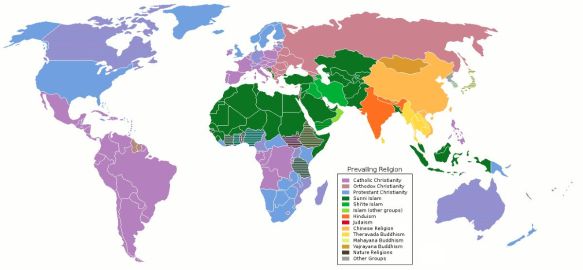
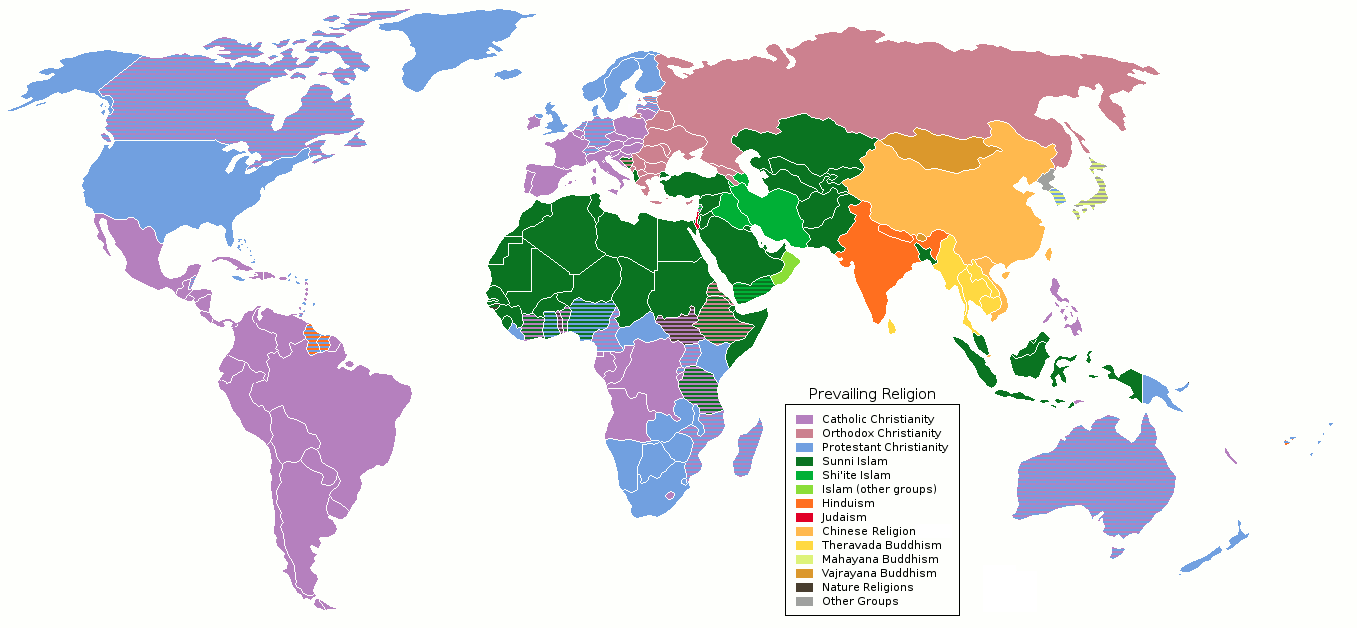
Everyone has probably seen a map of world religions where the colors of different regions identify the predominant local religion—Roman Catholicism in one color, Hinduism in another, and so on. To see what this reveals about the truth of religion, let’s first consider a map of World Science.

Imagine such a map. Over here is where scientists accept that the earth goes around the sun, and over there, it’s the other way around. This area is where they think astrology can predict the future, and that area is where they reject the idea. Intelligent Design thinking reigns in the blue area, and evolution in the green.

Naturally, each of these different groups see their opponents as vile heretics, and they have fought wars over their opposing beliefs. To keep it manageable, the map might only show battles with more than a thousand deaths.

Of course, the idea is ridiculous. A new scientific idea isn’t culturally or geographically specific, and, if validated, it peacefully sweeps the world. Astronomy replaced astrology, chemistry replaced alchemy, and germ theory replaced evil spirits as a cause of disease. One scientist should get the same results from an experiment as another, regardless of their respective religions. Muslims largely developed algebra, but there is no Muslim algebra. Christians largely developed physics, but there is no Christian physics. Evolution, germ theory, relativity, and the Big Bang are part of the consensus view among scientists, regardless of where they live or whether they are Christian or Muslim, Hindu or atheist.

While scientists have egos and aren’t perfectly objective, reluctance from the old guard only slows the inevitable. Contrast scientific progress with the idea that Shintoism will sweep across the West over the next couple of decades and replace Christianity, simply because it’s a theory that explains the facts of reality better. It works that way in science, not religion.

Let’s return to the map of world religions. Religions claim to give answers to life’s big questions, answers that science can’t give. Questions like, what is our purpose? Or, where did we come from? Or, what happens when we die?

But the map shows that the religious answers to those questions depend on where you are. If you live in Tibet or Thailand, Buddhism teaches that we are here to learn to cease suffering and reach nirvana. If you live in Malaysia or Morocco, Islam teaches that we are here to submit to Allah. In a mostly Christian country, “Man’s chief end is to glorify God, and to enjoy him forever,” according to the Westminster Shorter Catechism. Hinduism, Scientology, and all the rest—each has its own supernatural answers to these big questions, and each answer is not backed by evidence and must be taken on faith.

We ask the most profound questions of all, and the answers are location specific? What kind of truth depends on location?

For discovering reality, religion fails. Science follows the evidence, but religion is cultural. Next time someone nods their head sagely and says, “Ah, but Christianity can answer the big questions,” remember how empty that claim is.

Continue to chapter 2.

Image credit: Wikimedia, CC

Notes

Geocentrism: the astronomical model in which the earth is at the center of the universe. This model is less intuitive but much simpler than heliocentrism, developed by Nicolaus Copernicus in 1543, in which the earth orbits the sun.