
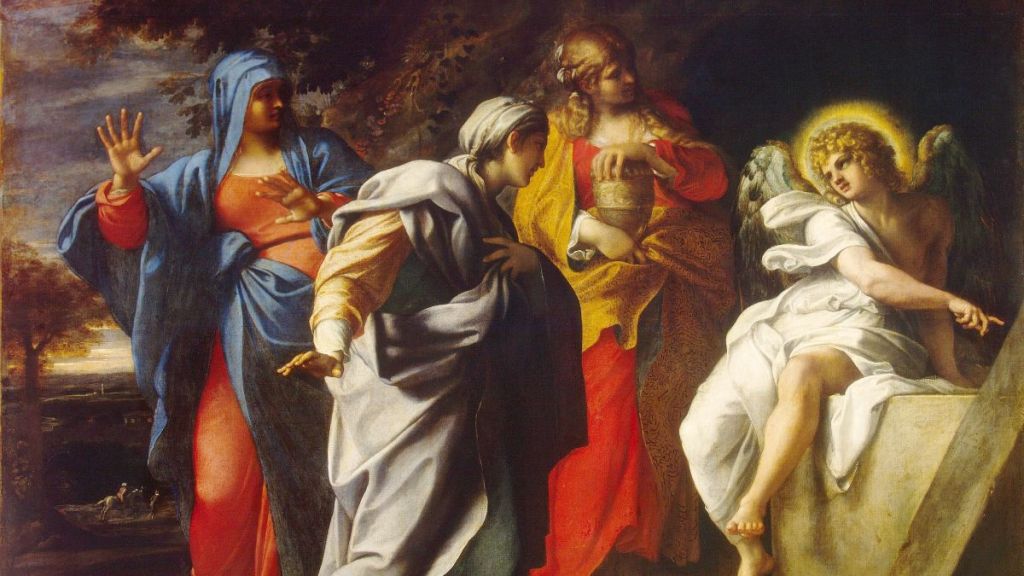
All four gospels say that women were the first to discover Jesus’s empty tomb. Many apologists point to this as an important fact, arguing that the gospels are reliable. Women had lower status than men in Jewish society of the time, and courts discounted their testimony. If the story were invented, who would have unreliable women discovering the empty tomb? These apologists tell us that the women’s important role is strong evidence for the truth of the resurrection story.
But the point isn’t that the story was invented, just that it’s not trustworthy history. The story documented in the gospels is the result of reworkings of existing stories and decades of oral history, and the story evolved and grew during that time.
Women’s unreliability is never an issue in the story—they discover the empty tomb, they tell men, the men verify the story, and then the men spread the word. If someone doesn’t like women as witnesses, they have the men.
That women were less reliable as witnesses in court doesn’t matter because there is no courtroom in the story. The women were trustworthy where it mattered: in conveying the news to people within their community who knew and trusted them.
Recall the story of Doubting Thomas. The other disciples told Thomas they saw Jesus face to face. Thomas didn’t automatically believe because men were the source; he disbelieved because the claim was incredible. The sex of the participants was irrelevant. Similarly, when the women reported an empty tomb, the apostles were amazed at the incredible claim and checked out the evidence themselves, just like Thomas.
Let’s imagine a different empty-tomb story. Suppose that, instead of women discovering Jesus had risen, the Bible had this incident:
At dawn on the first day of the week, Peter and Andrew entered the kitchen to prepare bread for the community. From the darkness in a corner, they heard a voice: “Why do you focus on minor matters when there is the Lord’s work to be done?” They realized it was Jesus, and they held His feet and worshiped Him.
What’s wrong with this incident? It’s that preparing bread is women’s work in this culture. It makes no sense to have men working in the kitchen.
The same is true for men dealing with the dead. The only excuse to visit the body after death was to apply spices, and within this culture that was women’s work. Only women could have discovered the empty tomb.
The Criterion of Embarrassment is often brought into situations like this. It’s easy to imagine a scribe touching up a passage so that it’s less embarrassing but not the reverse. That means that the more embarrassing alternative is likelier to be true. But women as important witnesses aren’t embarrassing, they’re unavoidable.
Believers might demand to know what explains the discovery of the empty tomb besides it being history, but of course, that assumes the accuracy of everything that happened in the story up to that point. It’s like demanding an explanation for Jack’s cutting down the beanstalk that could possibly be better than that there was a giant climbing down after him.
The Passion narrative is just a 2000-year-old story. It can’t support a supernatural explanation.
Continue to chapter 27.
Image credit: Annibale Carracci (public domain) via Wikimedia
Notes
Criterion of Embarrassment: When weighing two versions of a single passage, the more embarrassing one is less likely to have been added by a copyist later and is therefore more likely authentic.
Example: if women at the tomb was embarrassing but the gospel authors gritted their teeth and wrote it anyway, that argues that it really happened.
You can challenge this argument by asking if the “embarrassing” version was actually embarrassing in the eyes of the author.
Passion: The Passion is the Jesus story from his entrance in Jerusalem through the crucifixion. The word comes from the Latin passionem, “suffering, enduring.”
Doubting Thomas: John 20:24–29.
apply spices: Luke 24:1.
 2-Minute Christianity

For humor’s sake, consider the Roman Centurion who Jesus praised for having great faith. The Roman soldiers guarded the grave after the crucifixion. How difficult would it have been to roll the stone back quietly and make the corpse disappear?
We like to believe the supporters of Jesus were the only ones involved. A lot of Romans might have supported what Jesus taught because they didn’t like what was happening either. What better way to create a scene that make the corpse go away?
All I am saying is that short of aliens recording the whole thing, we will never know who came knocking in the middle of the night. This surprised the apostles and supporters and they did their part. The Roman soldiers could claim they guarded the tomb with a Centurion to back them up. Buried a few dozen yards away in an unmarked grave, the mastermind of a brilliant plot could rest in peace.
As a Christian, I like this story better because if I was there I would be part of it.
LikeLiked by 1 person
“All I am saying is that short of aliens recording the whole thing, we will never know who came knocking in the middle of the night.”
You act like there’s something puzzling here, but we have already a literary category labeled “Mythology and Legend.” That’s where the Bible goes.
I have no interest in playing, “Well, take the gospel story at this point; how do you explain the empty tomb?” (or any other facet of the story). If a Christian wants to do that, they need to first prove the Bible is history up to that point. Otherwise, it probably is what it looks like, just another fanciful tale from a period in time where people didn’t know where the sun went at night.
LikeLike
“If a Christian wants to do that, they need to first prove the Bible is history up to that point”.
This is an absurd burden of proof.
“just a fanciful tale from a period in time where people didn’t know where the sun went at night”.
These are your words about a drama and time that many people care deeply about. The first rule of being persuasive is not to say something so antagonizing that they don’t want to talk to you.
LikeLiked by 1 person
““If a Christian wants to do that, they need to first prove the Bible is history up to that point”. This is an absurd burden of proof.”
So then what *should* I be satisfied with from you? You’re claiming that a supernatural being created everything billions of years ago. Seems to me, I’m entitled to an enormous amount of evidence to back up that enormous claim.
LikeLike
You already know the truth. It is a mystery with evidence that 13 some billion years ago something happened that gave rise to the universe we know and our place in it. It is a mystery how life formed and gained consciousness and gave rise to us discussing this today. There is lots of evidence yet there is no proof in a material factual sense. In a spiritual sense no proof is needed either because you witness this.
LikeLiked by 1 person
Pingback: 25 Transcendental Argument: Where Does Logic Come From? | 2-Minute Christianity
The strongest evidence of an empty tomb is that neither the Romans, nor the Sanhedrin could produce the body of Jesus, despite everyone knowing where He was buried.
The only secular explanations are that the disciples stole the body, but this is highly unlikely as it was under guard.
There exists no reasonable secular explanation for where they body went…it is a glaring hole. Even Bart Erhman is left babbling with conjecture. It’s very unsatisfactory.
LikeLike
“The strongest evidence of an empty tomb is that neither the Romans, nor the Sanhedrin could produce the body of Jesus, despite everyone knowing where He was buried.”
The empty tomb appears in Mark 16. That was written in about 70 CE. At that point, the Romans and the Sanhedrin were just characters on paper. The author could do with them as he pleased.
LikeLike