
An ancient and curious map illustrates the backwards society we have inherited from Christianity.
Hereford Cathedral in England has the world’s largest mappa mundi, a parchment map of the world made in roughly 1300. This is not the kind of map we’re used to. It wouldn’t serve an explorer or navigator, and its creators didn’t claim that it would.
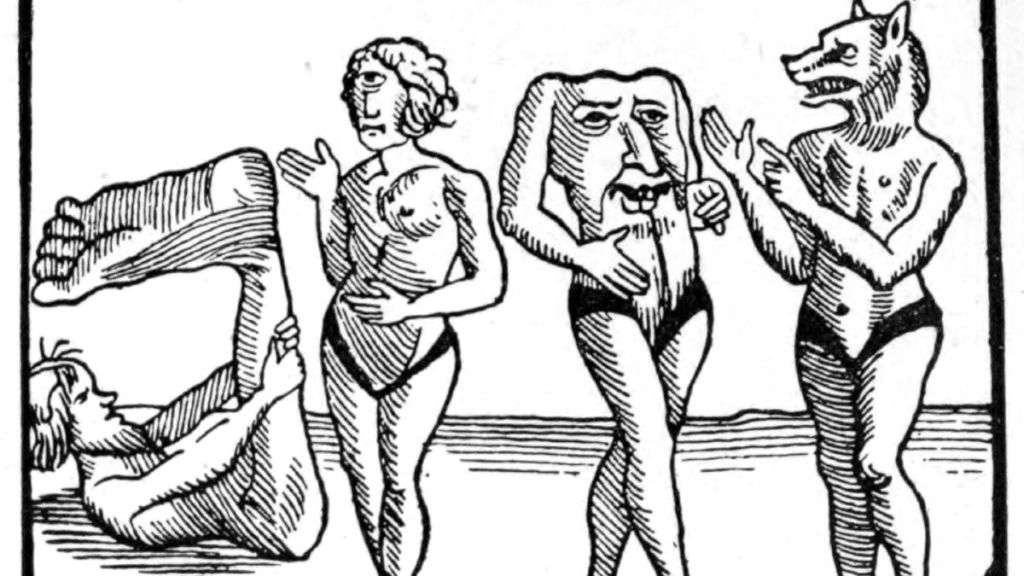
Using the theme of a world map, medieval cartographers embellished maps like this one to make them into something of an encyclopedia. With science in its infancy, however, the information can be bizarre, and the zoology sounds more appropriate for Alice’s Wonderland. This map documents the Sciapods, people with a single large foot that they used to shield themselves from the sun. The Blemmyes were warlike and had no head. Instead, their face was in their chest. The Cynocephali were dog-headed men, and Troglodites are “very swift; they live in caves, eat snakes, and catch wild animals by jumping on them.”
As with all mappae mundi, this one puts Jerusalem in the center. It shows places of biblical importance such as the Tower of Babel, the Garden of Eden, the route of the Exodus, and Sodom and Gomorrah. Mythology and history are mixed without distinction. We see Jason’s Golden Fleece and the Labyrinth where Theseus killed the Minotaur, but we also see the camp of Alexander the Great.
When Christianity was in charge, this is what it gave us. Mythical creatures populated the world, we had little besides superstition to explain the caprices of nature, and natural disasters were signs of God’s anger.
Christianity’s goal isn’t to create the internet, GPS, airplanes, or antibiotics. It isn’t to improve life with warm clothes or safe water. It isn’t to eliminate diseases like smallpox or polio. It’s to convince people to believe in a story that has negligible evidence.
Admittedly, it’s not like Europeans of the 1300s had many options, and Christianity might have offered a better explanation than nothing. Today, we have had a couple of centuries to test modern science, and we know that it delivers. Nevertheless, we still find God-centric mappa mundi thinking today. For example, the Westminster Shorter Catechism says that “Man’s chief end is to glorify God and to enjoy him forever,” not improve society, and even today some Christian leaders declare that natural disasters come from God.
If Christianity is what you create in the absence of science, why is it still here? The metaphor of assembling an arch illustrates the problem. First, build an arch-shaped scaffold. Next, lay the stones of the arch. Finally, remove the scaffold. Once the stones of the arch are in place, they support themselves and don’t need the scaffold.
That’s how religion works. Superstition in a world before science was the scaffold that supported the arch of religion. Science has now dismantled the scaffold of superstition, but the arch of religion has already calcified in place.
It’s the twenty-first century, and yet the guiding principles for Christians’ lives might as well come from the fourteenth, back when the sun orbited the earth, disease had supernatural causes, and distant lands had Sciapods, Blemmyes, and Troglodites.
Continue to chapter 11.
Image credit: Wikimedia (public domain)
 2-Minute Christianity
.png)
Pingback: 9 Original Sin: God’s Punishment of Adam and Eve | 2-Minute Christianity
Just because we have a modern world, this does not mean that average people are ready for it. Around the world, nations are struggling with the effects of rapid industrialization and urbanization complete with falling birth rates and political polarization. The amount of information that one must know to be a full citizen has risen steadily since the 1920’s and is no something like 4 million items and pushing the limits of average human capacity.
Beware of blaming people who support a system of beliefs for the actions of some of their members. The heart of Antisemitism and Islamaphobia is blaming all members for the actions of extremists.
Jesus taught that loving our neighbors as ourselves would lead to a better society. It is up to each of us to figure out how best to do this.
LikeLiked by 1 person
Jesus didn’t invent the Golden Rule.
LikeLike
So? I can buy many cleaners at a grocery store. They all clean. Is one better than the other?
LikeLiked by 1 person
Thor: Welcome!
“So?”
So Jesus sharing with us the Golden Rule isn’t that big a deal. It’s not like he’d have to be supernatural to do so.
LikeLike
Thor: are you a renaming of zarhoth? If so, congrats on the successful name change.
LikeLike
It appears when I comment anonymously, I get my name. If I am logged in its zarhoth. Personally Thor is the root of the word “Terror” so Zarhoth might actually be an improvement.
LikeLike